Verbal De-Escalation Training for Officers using AI in Virtual Reality
By embedding AI-driven, scenario-based VR training into everyday law-enforcement training, Axon aims to halve U.S. police-involved gun deaths by 2033. Led the end-to-end research & design of this product — partnering closely with engineering to shape how the AI dispatch responses & feedback channel functions.
Axon’s mission is to Protect Life.
Research shows those opening phrases largely determine whether a situation escalates or resolves peacefully.
First 45 words spoken.
Most impactful touch point in an officer-public interaction. Traditional verbal-skills training—live role-plays, and periodic workshops—is expensive, time consuming, and difficult to scale.
Agencies can’t easily run one-on-one drills every month or even every quarter for each officer, and younger recruits struggle to internalize communication principles without repeated practice.
Why AI + VR: Unscripted, Unpredictable Scenarios to mirror real world encounters
Instead of scheduling live role-plays, agencies can drop officers into immersive, evolving scenarios on a headset. Advanced ML, NLP, and speech synthesis power virtual “subjects” and “dispatch” characters that react dynamically to the officer’s conversation and word choice—no pre-written branching scripts.

Source: Axon AI Team
That adaptability mirrors real-world unpredictability: a calm virtual subject can flare up if an officer’s language shifts; a tense subject can de-escalate when the officer shows genuine calm.
By late 2024, an alpha version had run with 5 agencies with major setbacks:
Buried character-mood controls kept users in the same subject, gaze-only interaction in VR caused frequent mis-clicks, no built-in dispatch channel forced trainers to fill in, and trainer-driven feedback resulted in inconsistent coaching.

Officers didn’t notice the hidden subject type tab—driven by their focus on quick entry—so they were stuck with the same subject and missed key learning objectives.
01
02
03
04
The pilot risked non-adoption. While overall as a business the company was trying to get market share, this ai product was going to be the company’s product suite differentiator.
Create a frictionless AI-powered Verbal training experience—that maximizes officer learning and throughputs.
3 guiding tenets—each balancing user needs, cross-functional feasibility, and business metrics.


Frictionless Entry ⎯ “Get In, Train, Move On”
Officers come to train already under stress; nothing should derail them before scenario start. They are already adapting to both VR and AI layers, so it must be effortless and lightning-fast to get them into scenarios without added friction.
1. Stepper-Based Flow
Clear indication on the different variations you can get during training setup, to maximize learning. Proceed only via “Next” buttons placed away from the gaze center, enforcing two intentional clicks per choice and preventing mis-clicks, thereby avoiding any user frustration.
2. “What to Expect” Screen
Hooked to AI for dynamic, scenario-specific intros. Signals “this is a guided exercise,” reducing performance anxiety and clarifying objectives before launch.
3. Teaching controls with mandatory system checks
By combining mic validation with an in-flow dispatch tutorial and teaching controls through motion—not extra text—we cut pre-training steps.
Impact: Reduced Confusion & Mis-Clicks

Enforcing intentional confirmations drove mis-clicks down from 20 % to 2 %.

Scenario start time shrank from ~5 min to under 2 min, enabling 3× more drills per headset.

Clear “What to Expect” guidance eliminated guesswork.
Tailored Realism ⎯ “Close to real life encounters”
Without realistic dialog patterns, dispatch interactions, and dynamic NPC behaviors, VR feels contrived—officers “go through the motions” rather than truly practice de-escalation.
1. Dispatch Integration
Introduced a dedicated “Dispatch” audio channel informed by in-depth officer research. We implemented a voice-command system where trainees activate dispatch by saying “[call sign] to radio” before speaking. Subtle audio cues of “radio static” further reinforce realistic communication dynamics.


I tested various interaction methods—including gestures, hand position and book-ending with voice commands to find the interaction thats as close to real life.
2. System Alerts Only During the Scenario
We restricted in-scenario messages to essential system alerts—mic/dispatch controls, “End Scenario” prompts, battery warnings, and basic navigation cues—and withheld any coaching or conversational feedback until the After-Action Review.
By reserving the feedback solely for operational guidance, we preserve immersion and ensure officers engage authentically with each drill.
Decided to go with voice triggers similar to “hey siri” or “hey google”
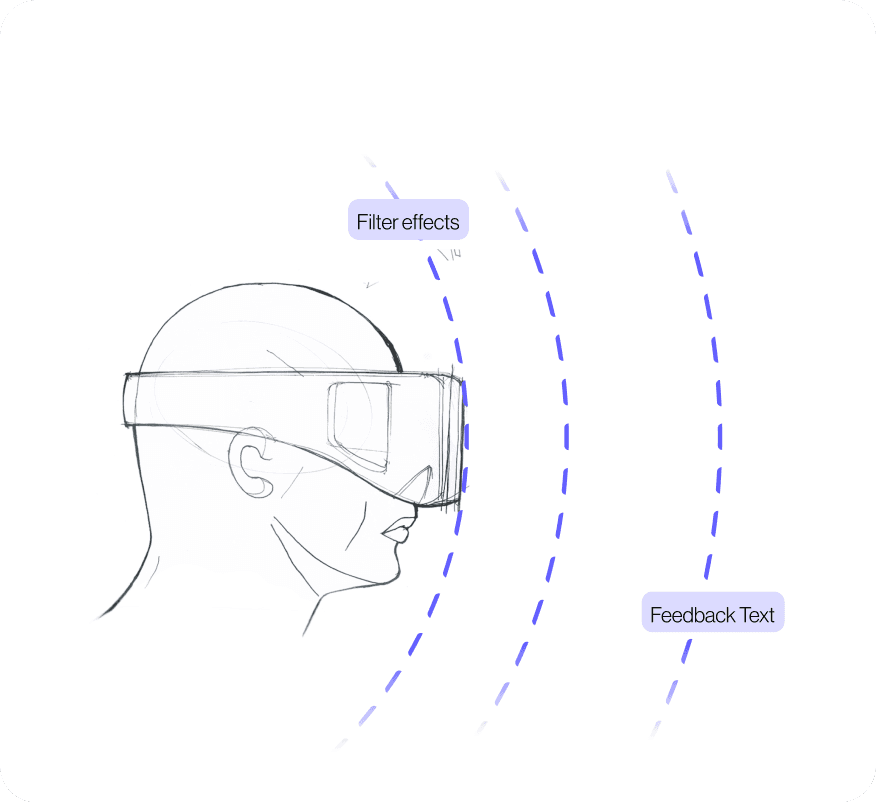
UI attached to headset

Nurturing, Actionable Feedback ⎯ “Coach Don’t Critique”
We learnt from research that trainees must demonstrate rapport-building with low-risk or agitated subjects, apply communication tactics that align with agency policies, and gather necessary information. Trainers also stressed on giving targeted, reasoned feedback (e.g., “you asked X; try phrasing Y to deepen rapport”) rather than vague praise or generic comments.
1. Bite sized tips on WTE Screens
Surfaced coaching tip on the “What to Expect” screen—pulled from officer workshops, Verbal Judo research, and agency materials—priming officers to repeat targeted communication strategies with confidence.

2. AI-Driven After-Action Review (AAR)
Prompt Iteration & IA: Iterated AI prompts on past transcripts, identifying missing elements such as clearly defined categories (eg: x,y,z) and the balance between objective positive feedback and actionable suggestion. Researched existing feedback rubrics, surveyed users to prioritize categories to land on three core buckets: x,y,z
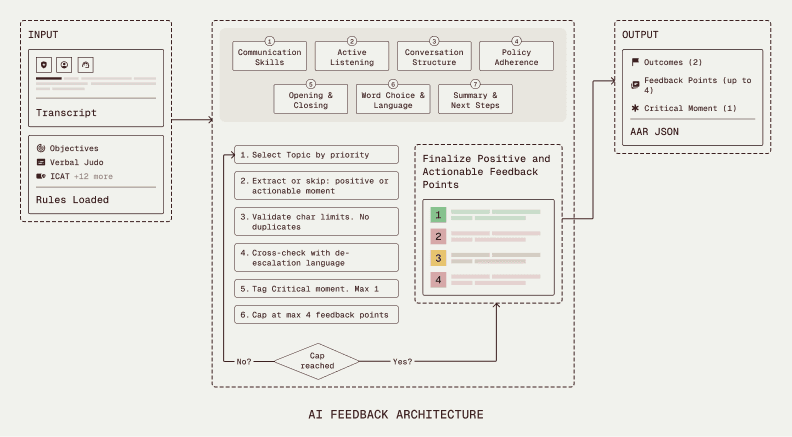
Visual Design: Created concise, feedback system with a timeline graph marking key timestamps with category icons. Added a timeline graph showing key timestamps with icons marking critical feedback—so officers can quickly locate and review each moment.
AAR screen recorded in headset
Impact: Increased Confidence & Trust
92% officers found after action review useful & actionable.
CSAT climbed from 3.4/5 to 4.4/5.
Acknowledgements
Product Management: Anne Hermes
Front End Engineering: Adam Rosyark
AI Research & Backend: Mark Cussick, Wright Esposito
Narrative Design: Shad Miller
Illustrations: Kim Lee
Case study written in collaboration with ChatGPT & Claude.