Verbal De-Escalation Training for Officers using AI in Virtual Reality
By embedding AI-driven, scenario-based VR training into everyday law-enforcement training, Axon aims to halve U.S. police-involved gun deaths by 2033. Led the end-to-end research & design of this product — partnering closely with engineering to shape how the AI dispatch responses & feedback channel functions.

Enforcing intentional confirmations drove mis-clicks down from 20% to 2 %.

Scenario start time shrank from ~5 min to under 2 min, enabling 3× more drills per headset.
92% officers found after action review useful & actionable.
CSAT climbed from 3.4/5 to 4.4/5.
Axon’s mission is to Protect Life.
Research shows those opening phrases largely determine whether a situation escalates or resolves peacefully.
First 45 words spoken.
Most impactful touch point in an officer-public interaction. Traditional verbal-skills training—live role-plays, and periodic workshops—is expensive, time consuming, and difficult to scale.
Agencies can’t easily run one-on-one drills every month or even every quarter for each officer, and younger recruits struggle to internalize communication principles without repeated practice.
The alpha trained the wrong thing, the hard way
By late 2024 an alpha had run with five agencies. The idea worked. The product did not.
Character-mood controls were buried, so officers stayed on the same subject and missed the learning objective. Gaze-only interaction in VR produced constant mis-clicks. There was no built-in dispatch channel, so trainers filled in by voice. Feedback was trainer-driven, which meant coaching quality changed person to person. Officers were trying to get into a scenario fast. They never found the hidden subject-type tab.
The pilot risked non-adoption. While overall as a business the company was trying to get market share, this ai product was going to be the company’s product suite differentiator.
Create a frictionless AI-powered Verbal training experience—that maximizes officer learning and throughputs.
3 guiding tenets—each balancing user needs, cross-functional feasibility, and business metrics.


Frictionless Entry ⎯ “Get In, Train, Move On”
Get in, train, move on. Officers arrive already under stress. Setup became a stepper with Next placed away from gaze center, so each choice takes two intentional clicks. A What to Expect screen, hooked to AI, tells them this is a guided exercise before they launch. Mic checks and dispatch teaching happen in motion, not as extra reading.
Tailored Realism ⎯ “Close to real life encounters”
Close to a real encounter. I tested gestures, hand position, and voice book-ends, then shipped a dedicated dispatch channel: say “[call sign] to radio,” hear static, talk. In-scenario UI is limited to system alerts. Coaching waits for the After-Action Review so the drill stays immersive.
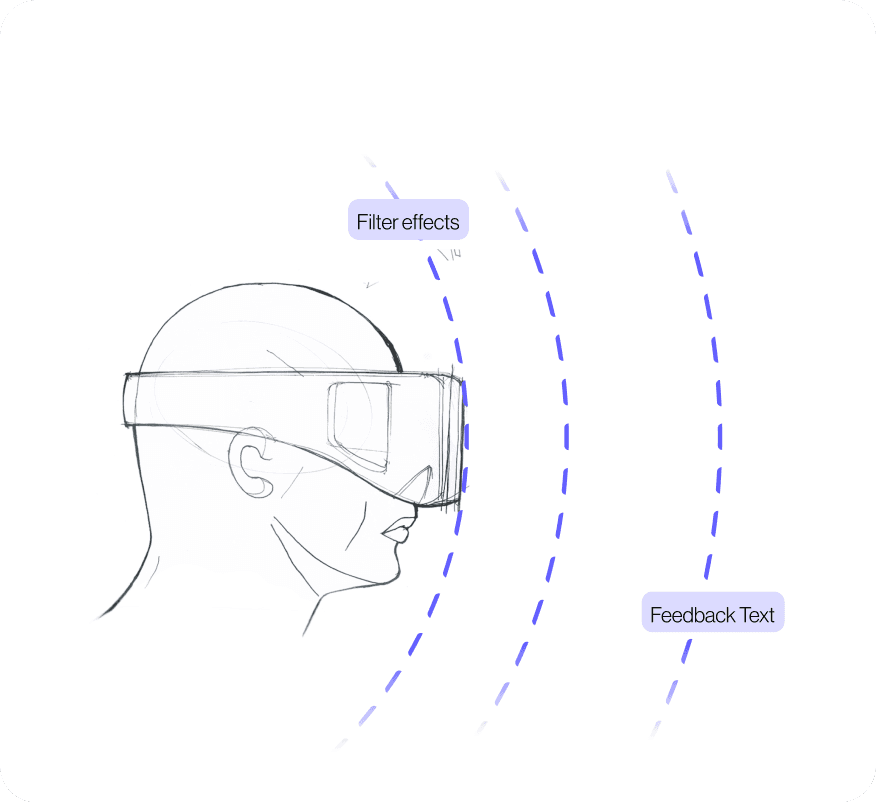
UI attached to headset

Actionable Feedback ⎯ “Coach Don’t Critique”
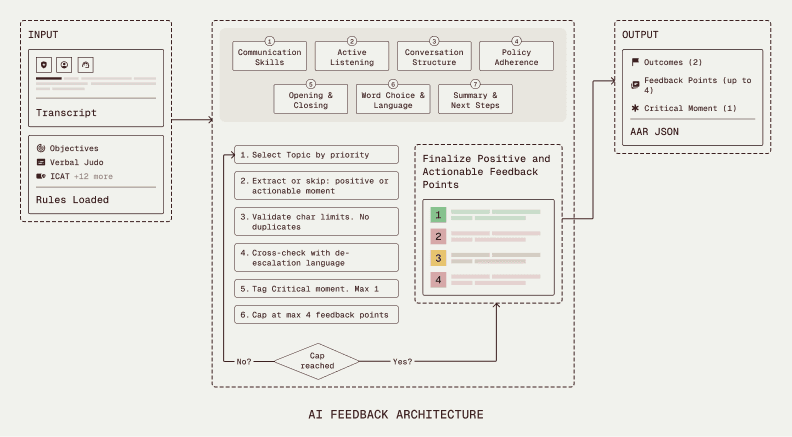
Coaching tips land on the What to Expect screen. The After-Action Review is AI-driven: prompts iterated on real transcripts, categories surveyed with users, then a timeline with icons so an officer can jump to the moment that mattered.
A path from headset on to review, with no extra ceremony
The shipped experience is the three tenets made concrete: stepper setup, a scenario-specific briefing, voice dispatch that behaves like a radio, silence during the drill except for system alerts, and an After-Action Review that points at timestamps instead of a wall of notes.